 |
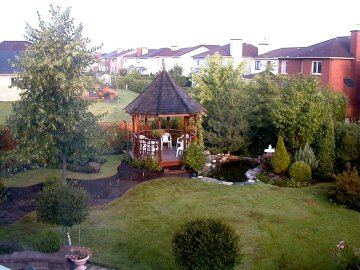
At the end of the summer, 2000, we dug out the course of the
stream and prepared the flower beds behind it. This was our
starting point in 2001.
|
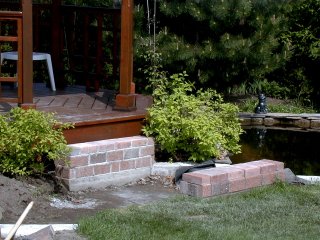 |
The bridge supports had a cement base, topped with bricks
cemented into place.
|
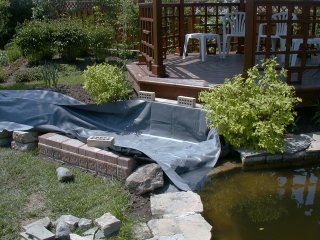 |
The rubber liner is draped over and into the pond, overlapping so
that the water will flow into the pond without any leakage.
|
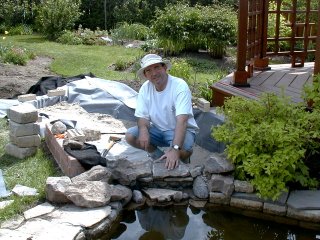 |
John is cementing the stones which will provide the
cascade into the pond.
|
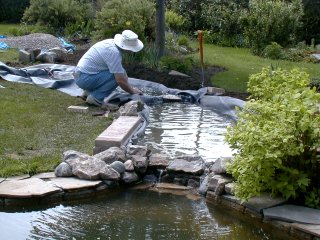 |
Two sections of the stream have now been lined and filled with
water. With every section, it's important to run the hose into
it, to test how it flows over the cascades. It's easier to
make adjustments earlier rather than later.
|
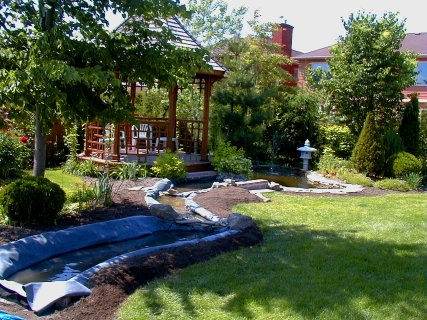 |
Three sections of the stream have now been lined and filled with
water.
|
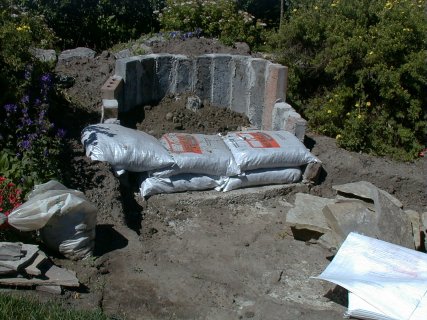 |
The final section of the stream, includes the waterfall.
A firm concrete foundation and some bags filled with clay
will ensure that the waterfall will not collapse over time.
This will then be covered with rubber liner. |
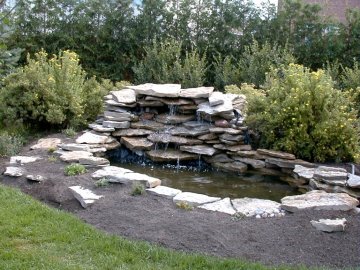 |
The waterfall is then constructed using rocks, and filling
any holes at the back with bags of sand The rubber liner
is hidden by flagstone and river stone. The rocks are
arranged to provide a nice cascade for the water.
|
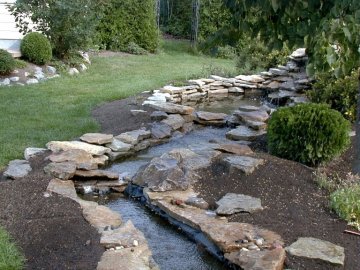 |
Large flagstone rocks are placed along the edge of the stream,
to hide the rubber liner.
|
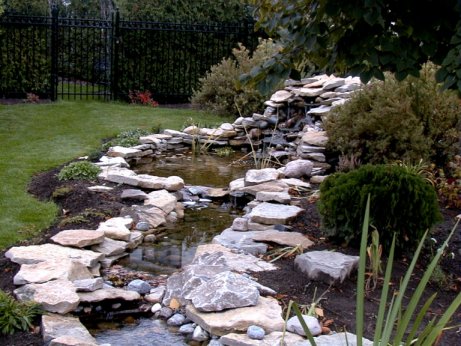 |
Then river stone is placed inside the stream and at the edges to
hide the rest of the liner.
|